
The Strategic Imperative: Developing a Resilient Cybersecurity Strategy
Introduction: Bridging the Gap Between Technology and Business
In the dynamic digital landscape, cybersecurity often remains relegated to a tactical, technology-driven function—a reactive effort focused on patching vulnerabilities and managing firewalls. However, true digital resilience requires a shift in perspective: cybersecurity must be elevated to a core business strategy that protects value, enables innovation, and manages enterprise risk at the highest level.

A security strategy is not merely a list of tools or a compliance checklist; it is a meticulously crafted roadmap that aligns technical capabilities directly with organizational objectives, risk tolerance, and projected growth. Without this strategic alignment, security investments often become fragmented, expensive, and ineffective, resulting in a state known as the “Security Strategy Gap.” This gap creates vulnerabilities not just in the network, but in the enterprise’s ability to execute its mission.
At Eden Kandinsky, we recognize that a successful cybersecurity strategy must be predictive, quantifiable, and integrated. Our Cybersecurity Strategy Development Service is designed to transform security from a cost center into a resilient, competitive advantage, ensuring that every defense mechanism, policy, and human action supports the overarching goals of the business. We help our clients achieve clarity on their current risk posture and build a sustainable security architecture that protects their digital future.
I. The Strategic Imperative: Defining the Need for Strategy
The fundamental difference between security tactics and security strategy lies in perspective, longevity, and alignment. Tactics are the actions (e.g., implementing multi-factor authentication); strategy is the plan that dictates why, where, and when to implement those tactics to meet a long-term goal.
The Problem with Tactical Security
Many organizations suffer from a reactive security model characterized by:
- Fragmented Tooling: A patchwork of solutions purchased in response to specific threats or audit findings, leading to complexity and high operating costs.
- Unquantified Risk: Inability to communicate cybersecurity risk in financial, business-relevant terms to executive leadership and the board, resulting in under- or mis-investment.
- Compliance-Only Focus: Treating security solely as a compliance burden (checking boxes) rather than a proactive defense against motivated adversaries.
- Talent Burnout: Security teams constantly chasing immediate threats without a clear, defined roadmap or strategic prioritization.
The Value of a Strategic Approach
Eden Kandinsky’s service addresses these shortcomings by establishing a strategy that is:
- Business-Centric: Starting with a deep understanding of core revenue streams, critical assets (the “crown jewels”), and organizational risk tolerance.
- Risk-Driven: Prioritizing investments based on quantifiable impact, ensuring resources are allocated to mitigate the highest probability, highest-impact threats.
- Future-Proof: Designing a security architecture that is flexible enough to accommodate future business initiatives, cloud adoption, digital transformation, and emerging regulatory requirements.
Our strategic development ensures that every dollar spent on security is traceable back to a measurable reduction in enterprise risk and a quantifiable improvement in business resilience.
II. The Eden Kandinsky Strategic Framework: A Phased Approach
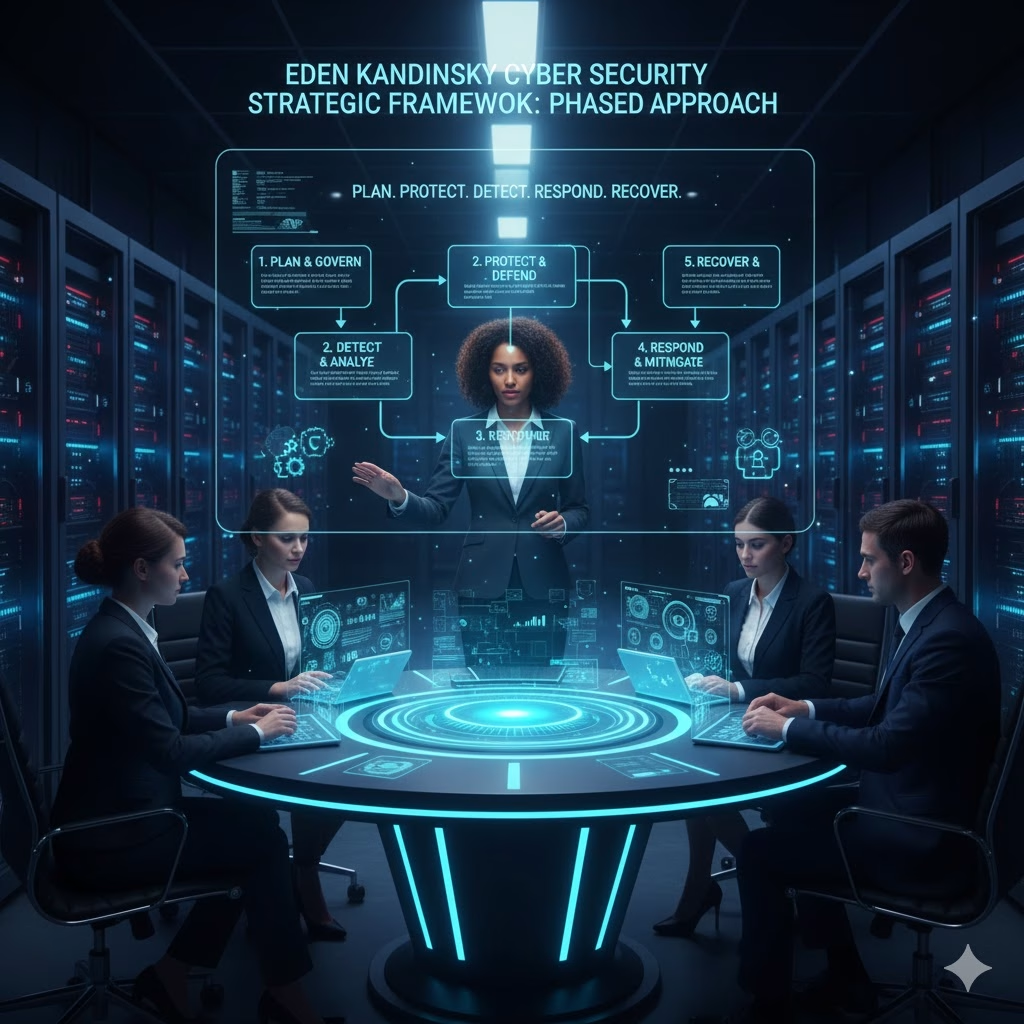
Our strategy development methodology is a rigorous, three-phase framework designed to deliver a comprehensive, actionable, and board-ready strategy document and implementation roadmap. This approach moves methodically from discovery to architecture to sustainable operations.
Phase 1: Discovery and Risk Quantification – The Current State
The goal of Phase 1 is to achieve an unvarnished, quantifiable understanding of the current security maturity and threat landscape. This provides the essential baseline for all future decision-making.
A. Stakeholder Alignment and Business Impact Analysis (BIA)
The process begins with in-depth interviews across all critical organizational units, including IT, Legal, Finance, Operations, and the C-suite. We identify the top three to five business objectives (e.g., Q3 product launch, expansion into the APAC market) and map them against the underlying technological dependencies. The BIA identifies critical systems—those whose downtime or compromise would cause significant financial, reputational, or legal damage—establishing the “crown jewels” that the strategy must unconditionally protect.
B. Security Maturity and Control Assessment
We conduct a structured assessment, typically leveraging leading frameworks such as the NIST Cybersecurity Framework (CSF), ISO 27001, or sector-specific frameworks (e.g., MITRE ATT&CK for threat modeling). This involves reviewing existing policies, procedures, technical configurations, and controls across all domains (Identity, Data, Network, Cloud, Endpoint). The result is a quantified maturity score and a clear inventory of control gaps.
C. Threat Modeling and Risk Quantification
This is the most crucial differentiator of a modern strategy. We move beyond simple “High/Medium/Low” ratings to quantify risk financially. Using methodologies like Factor Analysis of Information Risk (FAIR), we model potential loss exposure (Annualized Loss Expectancy) for high-impact scenarios. For instance, instead of saying a vulnerability is “High Risk,” we state: “Failure to implement proper network segmentation exposes the organization to a $5 million probable loss over the next three years due to ransomware contagion.” This allows executives to compare security investments against tangible financial risk reduction.
Phase 2: Architectural Blueprinting and Roadmap – The Target State
Phase 2 translates the quantified risk gaps from Phase 1 into a cohesive, targeted security vision and a clear plan to achieve it.
A. Target State Architecture (TSA) Design
We develop a conceptual future-state security architecture, prioritizing defense-in-depth principles. This blueprint includes:
- Zero Trust Model: Redefining network access based on the principle of “never trust, always verify,” regardless of user location.
- Unified Identity & Access Management (IAM): Consolidating disparate authentication systems into a single, centralized identity plane, critical for cloud and remote work environments.
- Data Security Posture: Defining data classification standards and implementing controls (encryption, masking, DLP) based on data sensitivity across all storage locations (on-premise, public cloud, SaaS).
- Technology Rationalization: Identifying redundant or underutilized security tools and recommending a simplified technology stack to reduce complexity and training overhead.
B. The Multi-Year Strategic Roadmap
The strategy culminates in a phased, financially justifiable roadmap, typically spanning 3 to 5 years. Initiatives are prioritized based on the financial risk reduction achieved and ease of implementation.
- Year 1 (Foundational): Focus on closing immediate, high-quantified risks, implementing core identity and segmentation controls, and operationalizing KRI (Key Risk Indicator) reporting.
- Year 2 (Optimization): Focus on security automation, advanced threat detection (XDR/SIEM expansion), and hardening application security practices.
- Year 3+ (Innovation): Focus on advanced concepts like confidential computing, threat hunting, and adopting Post-Quantum Cryptography (PQC) readiness.
The roadmap ensures that security funding is seen not as an expense, but as a series of planned, phased investments with measurable returns on security (ROS).
Phase 3: Operationalization and Governance – The Sustainable Framework
A strategy is only as effective as its execution and maintenance. Phase 3 focuses on embedding the strategic framework into the organization’s DNA.
A. Governance and Reporting Structure
We establish a formal security governance model, including a dedicated Security Steering Committee comprising senior leaders from across the business. This committee is responsible for approving strategic investments, monitoring risk exposure, and resolving cross-functional security issues. We define a clear set of KPIs (Key Performance Indicators) and KRIs that track execution progress and measure risk reduction over time, ensuring accountability.
B. Policy Framework Modernization
Existing security policies are often outdated or disconnected from operational reality. We modernize the policy framework to align with the new Target State Architecture and regulatory environment, creating clear, concise policies for domains like acceptable use, incident response, and third-party risk management. Crucially, these policies are designed to be enforceable and auditable.
C. Continuous Improvement and Strategy Review
Cyber adversaries and technology evolve rapidly. The strategy itself must be a living document. We define a schedule for annual strategic reviews, triennial BIA refreshes, and continuous automated reporting on KRIs. This ensures the strategy remains relevant and security posture adapts proactively to market shifts, merger and acquisition activities, and changes in the global threat landscape.
III. Beyond Technology: Strategic Pillars of Resilience
A truly resilient cybersecurity strategy recognizes that security is a composite function supported by three interdependent pillars: People, Process, and Technology. While technology provides the tools, the human and operational elements determine success or failure.
1. The People and Culture Pillar
The human element remains the most commonly exploited vulnerability. Our strategy addresses this through:
- Security Culture Program: Moving beyond generic, annual training to creating role-specific, continuous awareness campaigns that foster a culture where every employee views themselves as a frontline defender.
- Executive Buy-In: Training and briefing executive leadership on cyber-risk management, ensuring they understand their fiduciary duty regarding security and empowering the CISO as a strategic business partner.
- Talent Strategy: Assessing the current skill gaps in the security team (e.g., cloud security architects, threat hunters) and defining a long-term plan for recruitment, upskilling, and retention.
2. The Process and Governance Pillar
Effective security relies on repeatable, measurable processes that manage risk consistently.
- Integrated Risk Management (IRM): Integrating cybersecurity risk management into the broader enterprise risk management (ERM) framework, ensuring that cyber risks are treated with the same rigor as financial or operational risks.
- Incident Response (IR) Maturity: Developing and testing a sophisticated, cross-functional incident response plan that simulates high-impact events. This includes defining clear communication trees, legal response procedures, and external forensic engagement strategies to minimize dwell time and operational disruption.
- Third-Party Risk Management (TPRM): Creating a robust process for assessing the security posture of vendors and partners before engagement, and continuously monitoring their compliance throughout the contract lifecycle, recognizing that the supply chain is a prime attack vector.
3. Compliance and Regulatory Alignment Pillar
Compliance is a necessary but not sufficient condition for security. Our strategy uses regulatory requirements as a baseline while future-proofing the organization against emerging global mandates.
- Control Mapping: Using the strategy framework (e.g., NIST CSF) as the central control repository and mapping all regulatory requirements (GDPR, CCPA, HIPAA, etc.) back to these single controls. This eliminates audit duplication and simplifies compliance management.
- Geo-Political Preparedness: Anticipating the impact of emerging regulations, such as the European Union’s Digital Operational Resilience Act (DORA) or evolving AI governance frameworks, and strategically positioning the organization for early adoption and compliance.
IV. The Value of Strategic Partnership with Eden Kandinsky
Developing a truly integrated, risk-quantified cybersecurity strategy requires specialized expertise that goes beyond day-to-day operations.
As Eden Kandinsky, we bring a unique combination of offensive security insight (informed by our deep penetration testing experience) and strategic executive advisory. We don’t just tell you what is wrong; we use quantitative metrics to tell you how much it will cost if you don’t fix it, and we provide the phased roadmap to remediation. Our experience in translating complex technical findings into clear financial language empowers executive teams to make informed, rational decisions about security investment, ultimately driving enduring digital resilience.
Conclusion: From Strategy to Sustainable Security
The digital frontier demands a strategic, adaptive, and business-focused approach to cybersecurity. By engaging Eden Kandinsky’s Cybersecurity Strategy Development Service, organizations move beyond the reactive cycle of threat management to establish a security posture that is robust, measurable, and aligned with core business objectives. We provide the architectural blueprint, the financial justification, and the governance structure necessary to transition from tactical firefighting to sustainable, strategic security leadership. The time for a reactive approach is over; the future belongs to those who define their defense strategically.